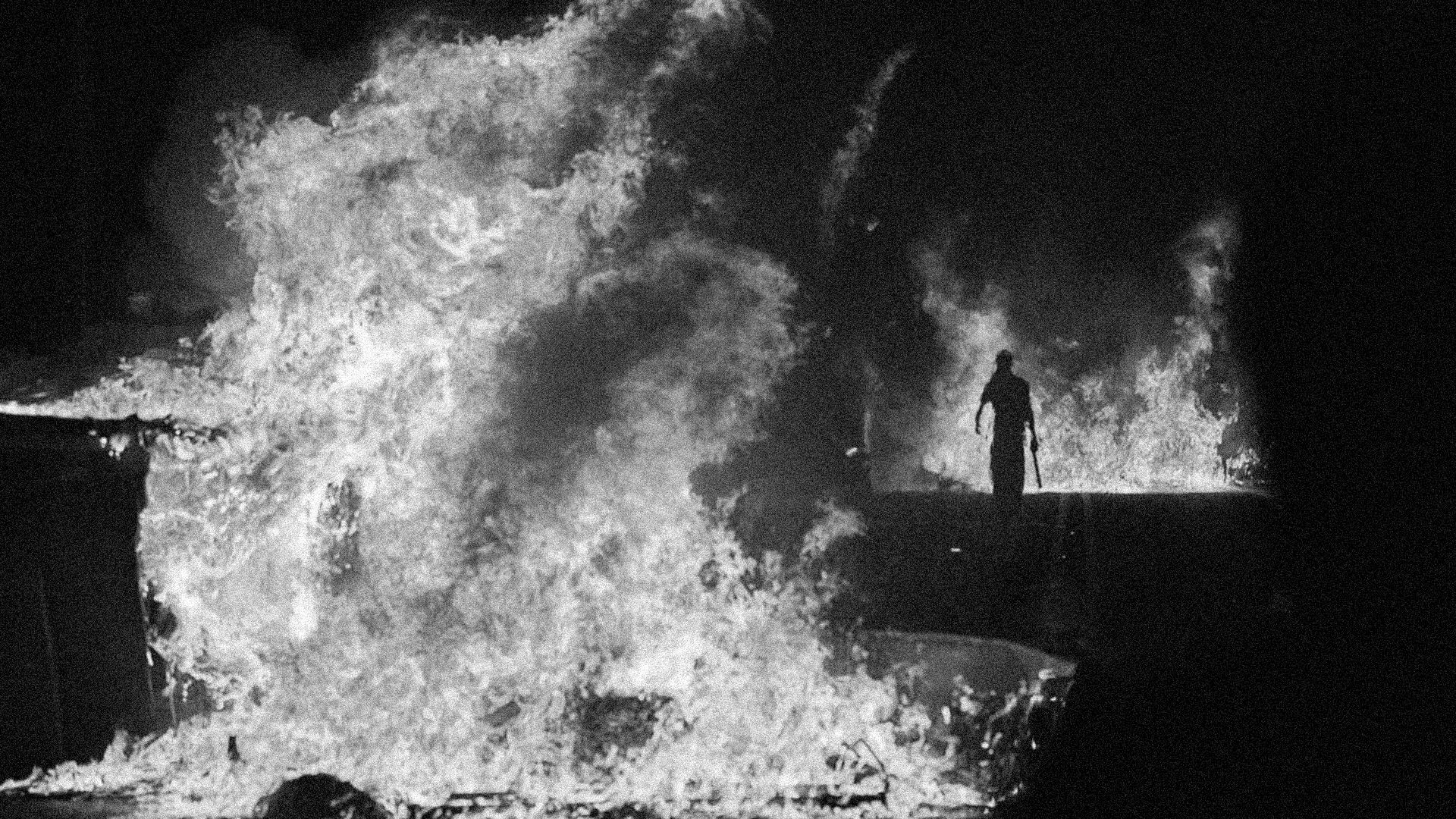
What a pleasure it is to wake up each morning and see revolts spread further across Europe, to see more and more people breaking with the misery of this world, and to see the contagious joy that is inherent in such ruptures. These revolts may at first glance appear disconnected and fleeting, like lonely sparks that flash to life in the night air only to quickly burn out. And yet even as they are each shaped by the distinct realities of where they unfold, these revolts nonetheless produce a shared sense of something that is not reducible to any one place, a sense that we remain alive and that life remains worth defending, an insurgent sense that circulates between places, and accumulates within each of them. In encampments, assemblies, strikes, demonstrations, and riots, the bleak truth of this world begins to crumble, while the truths of other worlds and ways of life come to be spoken with ever greater ease and fluency, whispered between friends and shouted on the streets, giving consistency to unruly dreams and desires that so far have managed to survive every effort to extinguish them.
And yet the sense of joy that can be found in these revolts also leaves a bitter aftertaste in our mouths, as in between each brilliant eruption we find ourselves nonetheless drawn back into an increasingly desolate normality, returning to the immiseration of work, attending exams in collapsing school systems, worrying about the next depressing election, and so on without end. This bitterness follows from the reality that we all already know that things are only getting worse, and yet we also know that these worsening things can indefinitely just go on and on. Among the most severe tragedies of our time is that poverty, evictions, prisons, war, and genocide are allowed to continue such that they have come to be taken as business as usual, constituting nothing less than the background of our existence, the texture of our lives. That the world simply goes on in this way is the catastrophe we now confront, a catastrophe that we can only hope to stop by putting an end to the world that is so eager to sustain it.
Each day we live our lives, we always do so in media res, in the middle of things. Behind us lies all of history, the aggregation of everything beautiful and horrible that has already occurred, and ahead of us lie futures still unwritten and unknown, which will too in time become past. But what is this world that we now find ourselves in the middle of? Everywhere it appears in crisis, offering at best only to superficially slow down or soften the desolation which we can see continuously cheapening and bringing ruin upon each detail of our existence. Scientists tell us the climate crisis is erasing species after species from the Earth, those who dare to protest are greeted with the clubs of riot police and with toxic clouds of tear gas, and billionaires from Silicon Valley let us know that AI will soon take away all of our jobs, select targets for military drones, and automatically surveil every street and city. All the while, governments are divided between a left that only wants to indefinitely manage and administer this misery, and a right that only wants to turn it into a carnival of cruelty within which they can turn the rounding up and disposal of undesirables into a spectacle for all to enjoy.
The present, the middle that we are within, now has taken the shape of a trap within which we are caught, a trap within which the future looks only like an endlessly degraded and depleted version of the present, dragging us all down ever further into an abyss without apparent end. We thus must struggle to find another way of relating to our existence, one which doesn’t assume that we’ll remain always stuck and paralyzed within this world, with all its corrupt institutions and desolating economies. Which is to say, that even though in some existential sense we may always remain in media res, we too can search for our way towards being in extrema res, to not be forever trapped in the middle of things, but to sprint towards their end.
To understand ourselves as approaching the end of this history rather than being stuck within it is to understand that our task is nothing less than to bring an end to what sustains the misery and cruelty of this world, to bring an end to the history of capitalism, of the state, of colonialism, and of the West. In other words, we must accept that the condition of anything else being able to begin is the end of a world that now is synonymous only with environmental destruction, invasive security, and endless militarization, with the enrichment of tiny islands of luxury that ensure only the accelerating impoverishment of existence itself. To defend and struggle for the beauty and dignity of life requires nothing less than a demolition of a world that compels us to accept a hierarchy of life within which white is superior to nonwhite, man to woman, human to nature, and rich to poor, a hierarchy that degrades life and all of existence on these terms, leaving us to live within a severely wounded and impoverished reality deprived of all autonomy and meaning. Destruction thus arises as the condition of creation, just as Walter Benjamin noted that barbarians reduce things to rubble not for the sake of the rubble, but for that of the way leading through it.
To desire to bring an end to the history within which we are caught requires embracing a happy nihilism, one which enthusiastically abandons all of the values of this world. We must let go of any hope that the state will find a way out of this situation, that the market will reach some kind of optimized and efficient equilibrium, as such hopes ultimately are only ways of remaining invested in what must be undone. Only when we’ve successfully abandoned the values and institutions that uphold this world and its history will we finally be free to cling to our existence and to one another on our own terms, and thus to no longer have our lives determined by the interests of political parties or the calculations of investment banks. Once we have left this world behind, nothing will be there to stop us from constructing a world based upon the immeasurable value of life, upon the desire to care for and cultivate the wealth of our common existence.
Everyday brings more and more people into revolts against the present order of things, into revolts that are coming to understand that the only way out is to push through all the way to the end of things. And so predictably, unions and political parties are racing to catch up and regain the initiative so as to ultimately pacify and domesticate what they cannot even faintly understand nor possibly recuperate. But fortunately for us, those who continue to take to the streets seem only to consistently shatter the hopes of these institutions, moving autonomously and without compromise, arising as a force that is perhaps best described by a Sciences Po university professor who noted that some of the revolts have found a way to act like an orchestra who knows the music so well that they do not need a conductor.
As we now look forward to the general strike in Spain in November, to further student uprisings in France, and to a multiplication of similar forms of revolt across Europe and hopefully further on still, we must find a way to break free of a world that guarantees only further impoverishment, repression, and degradation. What is needed is ultimately a sequence that breaks the present sequence of history, a disorder that breaks the present order of things. We need the temporality not of continuity but of breakage, a breakage which must be irreversible and which offers no possibility of return to what came before. Any capitulation or negotiation with the order of this world must thus be both understood and rejected as a form of surrender to the present, just as each act must be undertaken so as to bring us in some way closer to the end, to build upon the repertoires and intensities of the revolts so as the build the possibility of doing away with everything that rules over our lives today.
What is ultimately at stake in the question of breaking with this world is not a new political formation which would finally be capable of contesting or taking power, and much less some new form of collective political subjectivity that could serve as an organizing principle for a revived struggle on the terrain of the present order. What is required instead is something far more fierce and profound: a break with not only capital and the state, but with their forms of life, their ways of inhabiting the world. Or as a friend recently clarified, we must leave behind the old political cycles so as to throw ourselves into a properly anthropological cycle of struggle, departing from everything that has come to so strictly define what constitutes our lives in this world so as to arrive in a time within which the practice of living itself can unfold autonomously, collectively, and poetically. The reinvention of life in an era when life has come to be exhausted and subdued, the reinvention of our ways of existing in an era when existence itself has come to be cheapened and depleted, the reinvention of our ways of relating to one another and to the Earth in an era where all of our relationships have been reduced to forms of transaction and opportunities to dominate: this is the minimum program of what we must have the courage to pursue today.
If we look closely, we can already see this collective movement towards the end unfolding already all around, arising as autonomy being cultivated in the places we live, as an increasing capacity to give shape to our existence. It also arises as a building up of our friendships and relationships, which is also a building up of our capacities and intellects, of our courage and our strength. And ultimately, it arises as everyone who no longer accepts that this world and its history is the terrain upon which we must play, the terms that we must settle for, the dismal purgatory that we have all been condemned to live and ultimately die within. So let’s turn away from the desperate pleas of political parties and from the tired strategies of the big unions, away from the demands that we remain reasonable in a world whose reason has meant only continued suffering and devastation, and plan to meet one another instead at the end. As we set out to bring about the end of this world then, an end to the world of capitalism and of the police, let us take our cue from the poet Aimé Césaire, who asked a question nearly a century ago that still remains as incendiary today: “What can I do? One must begin somewhere. Begin what? The only thing in the world worth beginning: The End of the world of course.”