Author: Ian Alan Paul

  • Lo único que vale la pena empezar es el fin

    Lo único que vale la pena empezar es el fin

    Qué placer despertar cada mañana y ver cómo las revueltas se extienden por toda Europa, ver cada vez más personas romper con la miseria de este mundo, y ver la alegría contagiosa inherente a estas rupturas. A primera vista, las revueltas pueden parecer desconectadas y efímeras, como chispas solitarias que brillan en la noche para luego apagarse rápidamente. Sin embargo, aunque cada una esté marcada por las realidades específicas del lugar donde surgen, todas generan un sentimiento compartido que no se limita a un sitio concreto, un sentimiento de que seguimos vivos y de que la vida merece ser defendida, un sentimiento insurgente que circula entre distintos lugares y se acumula en cada uno de ellos. En campamentos, asambleas, huelgas, manifestaciones y disturbios, la abrasiva realidad de este mundo comienza a desmoronarse, mientras que las verdades de otros mundos y otras formas de vida empiezan a expresarse con mayor facilidad y fluidez, susurradas entre amigos y gritadas en las calles, dotando de consistencia a esos sueños y deseos indómitos que, hasta ahora, han logrado sobrevivir a todos los intentos por extinguirlos.

    Y, sin embargo, la sensación de alegría que puede hallarse en estas revueltas también nos deja un regusto amargo. Entre cada estallido fulgurante, nos vemos arrastrados de nuevo a una normalidad cada vez más desoladora: el retorno a la miseria del trabajo, la asistencia a exámenes en un sistema escolar en colapso, la preocupación por la siguiente elección desalentadora, y, así, sin conclusión. Esta amargura surge de la realidad de que todos sabemos de sobra que las cosas no hacen más que empeorar, y al mismo tiempo también sabemos que este deterioro puede prolongarse indefinidamente. Una de las tragedias más graves de nuestro tiempo es que la pobreza, los desahucios, las cárceles, la guerra y el genocidio se permitan continuar hasta el punto de ser considerados como algo habitual, constituyendo, ni más ni menos, el fondo de nuestra existencia, la textura de nuestras vidas. Que el mundo siga así es la catástrofe a la que nos enfrentamos hoy, una catástrofe que solo podremos detener si ponemos fin al mundo que tanto se empeña en mantenerla.

    Cada día que vivimos, lo hacemos siempre *in media res*, en medio de las cosas. A nuestras espaldas queda toda la historia, la acumulación de toda la belleza y todo lo horrible que ya ha ocurrido, y ante nosotros se extienden futuros aún no escritos ni conocidos, que con el tiempo también pasarán a formar parte del pasado. Pero ¿qué es este mundo en el que ahora nos encontramos situados? Por todas partes el mundo está en crisis. En el mejor de los casos, este mundo solo intenta ralentizar o mitigar superficialmente una desolación que, de forma constante, degrada y arruina cada detalle de nuestra existencia. Los científicos nos advierten que la crisis climática está borrando de la faz de la Tierra una especie tras otra, quienes se atreven a protestar se topan con las porras de los antidisturbios y con nubes tóxicas de gases lacrimógenos, y los multimillonarios de Silicon Valley anuncian que la inteligencia artificial pronto nos arrebatará todos nuestros empleos, seleccionará incontables objetivos para drones militares, y vigilará automáticamente cada calle y cada ciudad. Mientras tanto, los gobiernos se dividen entre una izquierda que solo aspira a gestionar y administrar indefinidamente esta miseria, y una derecha que pretende convertirla en un carnaval de crueldad, donde la captura y la eliminación de los «indeseables» se transforma en un espectáculo para el disfrute de todos.

    El presente, ese punto intermedio en el que nos encontramos, cobra así la forma de una trampa en la que estamos atrapados, una trampa en la que el futuro no se presenta sino como una versión cada vez más degradada y empobrecida del presente, arrastrándonos a todos hacia un abismo sin fin aparente. Por ello, debemos esforzarnos por hallar otra forma de relacionarnos con nuestra existencia, una que no dé por sentado que permaneceremos siempre atascados y paralizados en este mundo, con todas sus instituciones corruptas y sus economías desoladoras. En otras palabras, aunque tal vez siempre permanezcamos *in media res* en cierto sentido existencial, en medio de las cosas, también podemos buscar el camino hacia ser *in extrema res*, no quedar atrapados para siempre en el medio, sino lanzarnos a toda velocidad hacia el fin.

    Comprendernos a nosotros mismos como quienes se acercan al fin de esta historia, en lugar de estar atrapados en ella, significa entender que nuestra tarea no es otra que poner fin a aquello que sostiene la miseria y la crueldad de este mundo, poner fin a la historia del capitalismo, del Estado, del colonialismo, y de Occidente. En otras palabras, debemos aceptar que, para que cualquier otra cosa pueda comenzar, es necesario el fin de un mundo que hoy es sinónimo exclusivamente de destrucción ambiental, seguridad invasiva y militarización interminable, un mundo caracterizado por el enriquecimiento de minúsculas islas de lujo que solo garantizan el empobrecimiento acelerado de la existencia misma. Así, la destrucción se presenta como condición para la creación. Defender y luchar por la belleza y la dignidad de la vida exige nada menos que la demolición de un mundo que nos obliga a aceptar una jerarquía de la vida en la que lo blanco es superior a lo no blanco, el hombre a la mujer, el ser humano a la naturaleza, y el rico al pobre, una jerarquía que degrada la vida y toda la existencia bajo estos términos, condenándonos a vivir en una realidad profundamente herida y empobrecida, despojada de toda autonomía y significado. Como señaló Walter Benjamin: los «bárbaros» no destruyen por capricho, sino que reducen las cosas a escombros no por causa de los escombros, sino por el camino que conduce a través de ellos.

    Desear poner fin a la historia en la que estamos atrapados exige abrazar un nihilismo feliz, uno que abandone con entusiasmo todos los valores de este mundo. Debemos renunciar a cualquier esperanza de que el Estado encuentre una salida a esta situación, o de que el mercado alcance un equilibrio optimizado y eficiente. En última instancia, tales esperanzas no son más que formas de seguir vinculados a aquello que debe ser desmantelado. Solo cuando hayamos abandonado por completo los valores e instituciones que sostienen este mundo y su historia, seremos finalmente libres para aferrarnos a nuestra existencia y a los demás bajo nuestros propios términos, dejando así de permitir que nuestras vidas sean determinadas por los intereses de los partidos políticos o los cálculos de las firmas financieras. Una vez que hayamos dejado atrás este mundo, nada nos impedirá construir uno nuevo, fundamentado en el valor incalculable de la vida y en el deseo de cuidar y cultivar la riqueza de nuestra existencia común.

    Cada día, más y más personas se suman a revueltas contra el orden actual de las cosas, revueltas que empiezan a comprender que la única salida es seguir adelante hasta el fin de las cosas. Como era de esperar, los sindicatos y los partidos políticos se apresuran a reaccionar para recuperar la iniciativa, con el fin último de pacificar y domesticar aquello que ni siquiera alcanzan a comprender, y mucho menos a capturar. Pero, afortunadamente para nosotros, quienes siguen saliendo a las calles no hacen más que frustrar, una y otra vez, las esperanzas de estas instituciones, actúan de manera autónoma y sin concesiones, erigiéndose como una fuerza que quizá quede mejor descrita por un profesor de la universidad Sciences Po, quien señaló que algunas de estas revueltas han encontrado la forma de actuar como una orquesta que conoce tan bien la partitura que no necesita director.

    Ante la perspectiva de la huelga general en España en noviembre, de nuevas revueltas estudiantiles en Francia y de la multiplicación de formas de rebelión similares por toda Europa y, ojalá, más allá, debemos encontrar la manera de liberarnos de un mundo que solo garantiza un mayor empobrecimiento, represión y degradación. Lo que hace falta, en definitiva, es una secuencia que rompa con la secuencia histórica actual, un desorden que quiebre el orden del presente. Necesitamos una temporalidad que no sea de continuidad, sino de ruptura, una ruptura irreversible que no deje ruta a un posible retorno a lo que existía antes. Por tanto, cualquier capitulación o negociación con el orden de este mundo debe entenderse y rechazarse como una forma de rendición ante el presente. Del mismo modo, cada acción debe emprenderse con el fin de acercarnos, de una u otra manera, al desenlace, aprovechando los repertorios y la intensidad de las revueltas para construir la posibilidad de acabar con todo aquello que hoy rige nuestras vidas.

    Lo que está realmente en juego en la cuestión de romper con este mundo no es una nueva formación política que sea capaz de disputar o tomar el poder, y mucho menos una nueva forma de subjetividad política colectiva que sirva como principio organizador para una lucha renovada en el terreno del orden actual. Lo que se requiere, en cambio, es algo mucho más radical y profundo: una ruptura no solo con el capital y el Estado, sino con sus formas de vida, con sus maneras de habitar el mundo. O, como aclaró hace poco un amigo, debemos dejar atrás los viejos ciclos políticos para lanzarnos a un ciclo de lucha propiamente antropológico, alejarnos de todo aquello que ha llegado a definir de manera tan estricta lo que constituye nuestras vidas en este mundo, para así acceder a un tiempo en el que la práctica misma de vivir pueda desplegarse de forma autónoma, compartida y poética. La reinvención de la vida en una época en la que esta ha quedado agotada y sometida, la reinvención de nuestras formas de existir en una época en la que la existencia misma ha sido degradada y vaciada, la reinvención de nuestras maneras de relacionarnos entre nosotros y con la Tierra en una época donde todas nuestras relaciones se han reducido a formas de transacción y a oportunidades de dominación: este es el programa mínimo que hoy debemos tener el coraje de perseguir.

    Si observamos con atención, ya podemos ver este movimiento colectivo hacia el fin desarrollándose a nuestro alrededor, surge como una autonomía que se cultiva en los lugares donde vivimos, como una capacidad creciente para dar forma a nuestra existencia. Surge también a través del fortalecimiento de nuestras amistades y relaciones, lo que implica, a su vez, el desarrollo de nuestras capacidades e intelectos, de nuestra valentía y nuestra fuerza. Y, en última instancia, surge en todas aquellas personas que ya no aceptan que este mundo y su historia sean el terreno sobre el cual debemos jugar, las condiciones a las que debemos resignarnos, ese lúgubre purgatorio al que todos hemos sido condenados a vivir y, finalmente, a morir. Por tanto, apartémonos de las súplicas desesperadas de los partidos políticos y de las estrategias desgastadas de los grandes sindicatos, alejémonos de las exigencias de mantenernos «razonables» en un mundo cuya «razón» solo ha traído sufrimiento y devastación continuos. En su lugar, propongámonos encontrarnos, al fin, los unos con los otros. Al emprender la tarea de provocar el fin de este mundo, el fin del mundo del capitalismo y de la policía, sigamos el ejemplo del poeta Aimé Césaire, quien hace casi un siglo planteó una pregunta que hoy sigue siendo igual de incendiaria: «¿Qué puedo hacer? / Hay que empezar por alguna parte. / ¿Empezar qué? / Lo único en el mundo que vale la pena empezar: / El fin del mundo, por supuesto».
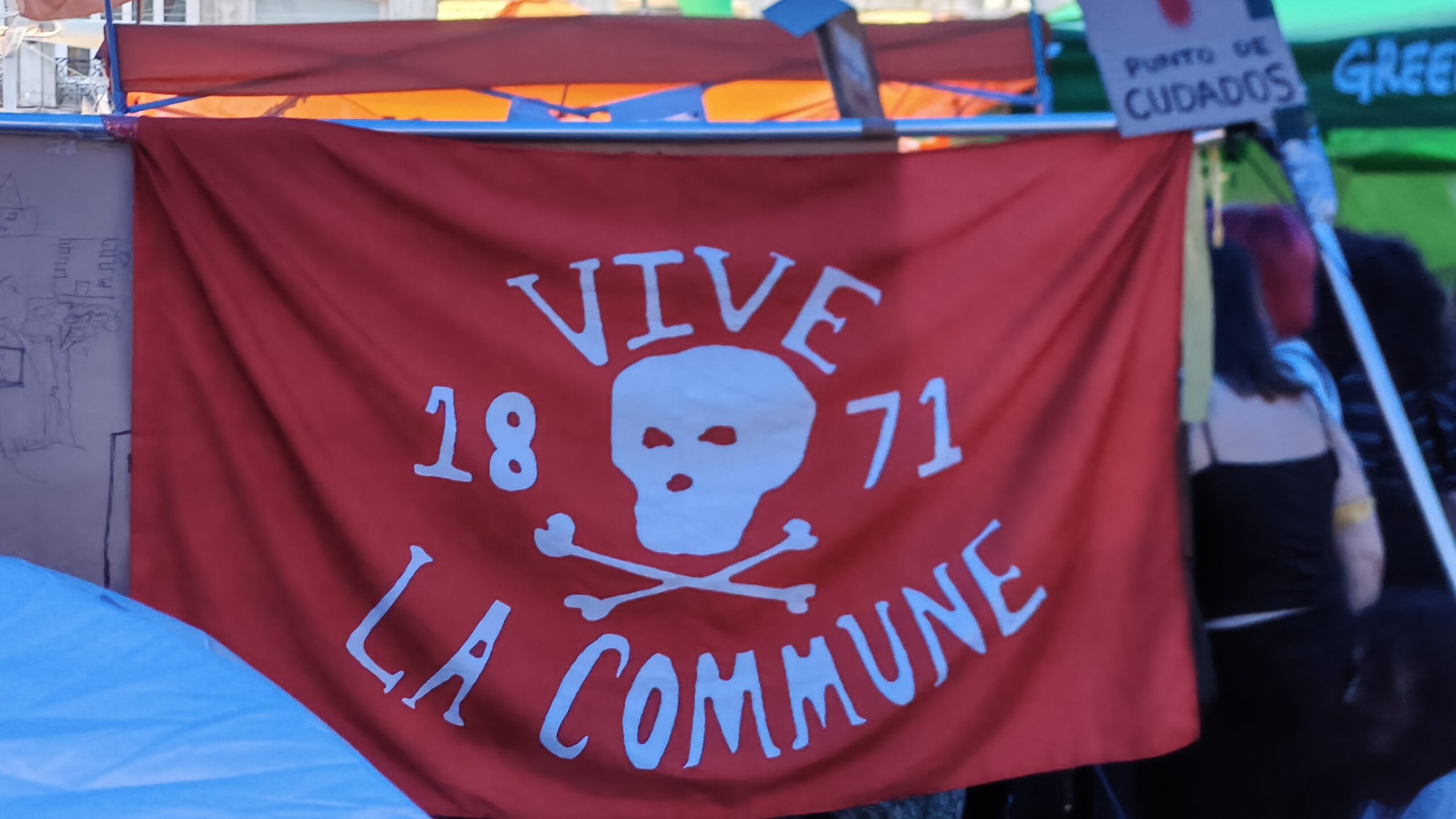
  • The Only Thing Worth Beginning is the End

    The Only Thing Worth Beginning is the End

    What a pleasure it is to wake up each morning and see revolts spread further across Europe, to see more and more people breaking with the misery of this world, and to see the contagious joy that is inherent in such ruptures. These revolts may at first glance appear disconnected and fleeting, like lonely sparks that flash to life in the night air only to quickly burn out. And yet even as they are each shaped by the distinct realities of where they unfold, these revolts nonetheless produce a shared sense of something that is not reducible to any one place, a sense that we remain alive and that life remains worth defending, an insurgent sense that circulates between places, and accumulates within each of them. In encampments, assemblies, strikes, demonstrations, and riots, the bleak truth of this world begins to crumble, while the truths of other worlds and ways of life come to be spoken with ever greater ease and fluency, whispered between friends and shouted on the streets, giving consistency to unruly dreams and desires that so far have managed to survive every effort to extinguish them.

    And yet the sense of joy that can be found in these revolts also leaves a bitter aftertaste in our mouths, as in between each brilliant eruption we find ourselves nonetheless drawn back into an increasingly desolate normality, returning to the immiseration of work, attending exams in collapsing school systems, worrying about the next depressing election, and so on without end. This bitterness follows from the reality that we all already know that things are only getting worse, and yet we also know that these worsening things can indefinitely just go on and on. Among the most severe tragedies of our time is that poverty, evictions, prisons, war, and genocide are allowed to continue such that they have come to be taken as business as usual, constituting nothing less than the background of our existence, the texture of our lives. That the world simply goes on in this way is the catastrophe we now confront, a catastrophe that we can only hope to stop by putting an end to the world that is so eager to sustain it.

    Each day we live our lives, we always do so in media res, in the middle of things. Behind us lies all of history, the aggregation of everything beautiful and horrible that has already occurred, and ahead of us lie futures still unwritten and unknown, which will too in time become past. But what is this world that we now find ourselves in the middle of? Everywhere it appears in crisis, offering at best only to superficially slow down or soften the desolation which we can see continuously cheapening and bringing ruin upon each detail of our existence. Scientists tell us the climate crisis is erasing species after species from the Earth, those who dare to protest are greeted with the clubs of riot police and with toxic clouds of tear gas, and billionaires from Silicon Valley let us know that AI will soon take away all of our jobs, select targets for military drones, and automatically surveil every street and city. All the while, governments are divided between a left that only wants to indefinitely manage and administer this misery, and a right that only wants to turn it into a carnival of cruelty within which they can turn the rounding up and disposal of undesirables into a spectacle for all to enjoy.

    The present, the middle that we are within, now has taken the shape of a trap within which we are caught, a trap within which the future looks only like an endlessly degraded and depleted version of the present, dragging us all down ever further into an abyss without apparent end. We thus must struggle to find another way of relating to our existence, one which doesn’t assume that we’ll remain always stuck and paralyzed within this world, with all its corrupt institutions and desolating economies. Which is to say, that even though in some existential sense we may always remain in media res, we too can search for our way towards being in extrema res, to not be forever trapped in the middle of things, but to sprint towards their end.

    To understand ourselves as approaching the end of this history rather than being stuck within it is to understand that our task is nothing less than to bring an end to what sustains the misery and cruelty of this world, to bring an end to the history of capitalism, of the state, of colonialism, and of the West. In other words, we must accept that the condition of anything else being able to begin is the end of a world that now is synonymous only with environmental destruction, invasive security, and endless militarization, with the enrichment of tiny islands of luxury that ensure only the accelerating impoverishment of existence itself. To defend and struggle for the beauty and dignity of life requires nothing less than a demolition of a world that compels us to accept a hierarchy of life within which white is superior to nonwhite, man to woman, human to nature, and rich to poor, a hierarchy that degrades life and all of existence on these terms, leaving us to live within a severely wounded and impoverished reality deprived of all autonomy and meaning. Destruction thus arises as the condition of creation, just as Walter Benjamin noted that barbarians reduce things to rubble not for the sake of the rubble, but for that of the way leading through it.

    To desire to bring an end to the history within which we are caught requires embracing a happy nihilism, one which enthusiastically abandons all of the values of this world. We must let go of any hope that the state will find a way out of this situation, that the market will reach some kind of optimized and efficient equilibrium, as such hopes ultimately are only ways of remaining invested in what must be undone. Only when we’ve successfully abandoned the values and institutions that uphold this world and its history will we finally be free to cling to our existence and to one another on our own terms, and thus to no longer have our lives determined by the interests of political parties or the calculations of investment banks. Once we have left this world behind, nothing will be there to stop us from constructing a world based upon the immeasurable value of life, upon the desire to care for and cultivate the wealth of our common existence.

    Everyday brings more and more people into revolts against the present order of things, into revolts that are coming to understand that the only way out is to push through all the way to the end of things. And so predictably, unions and political parties are racing to catch up and regain the initiative so as to ultimately pacify and domesticate what they cannot even faintly understand nor possibly recuperate. But fortunately for us, those who continue to take to the streets seem only to consistently shatter the hopes of these institutions, moving autonomously and without compromise, arising as a force that is perhaps best described by a Sciences Po university professor who noted that some of the revolts have found a way to act like an orchestra who knows the music so well that they do not need a conductor.

    As we now look forward to the general strike in Spain in November, to further student uprisings in France, and to a multiplication of similar forms of revolt across Europe and hopefully further on still, we must find a way to break free of a world that guarantees only further impoverishment, repression, and degradation. What is needed is ultimately a sequence that breaks the present sequence of history, a disorder that breaks the present order of things. We need the temporality not of continuity but of breakage, a breakage which must be irreversible and which offers no possibility of return to what came before. Any capitulation or negotiation with the order of this world must thus be both understood and rejected as a form of surrender to the present, just as each act must be undertaken so as to bring us in some way closer to the end, to build upon the repertoires and intensities of the revolts so as the build the possibility of doing away with everything that rules over our lives today.

    What is ultimately at stake in the question of breaking with this world is not a new political formation which would finally be capable of contesting or taking power, and much less some new form of collective political subjectivity that could serve as an organizing principle for a revived struggle on the terrain of the present order. What is required instead is something far more fierce and profound: a break with not only capital and the state, but with their forms of life, their ways of inhabiting the world. Or as a friend recently clarified, we must leave behind the old political cycles so as to throw ourselves into a properly anthropological cycle of struggle, departing from everything that has come to so strictly define what constitutes our lives in this world so as to arrive in a time within which the practice of living itself can unfold autonomously, collectively, and poetically. The reinvention of life in an era when life has come to be exhausted and subdued, the reinvention of our ways of existing in an era when existence itself has come to be cheapened and depleted, the reinvention of our ways of relating to one another and to the Earth in an era where all of our relationships have been reduced to forms of transaction and opportunities to dominate: this is the minimum program of what we must have the courage to pursue today.

    If we look closely, we can already see this collective movement towards the end unfolding already all around, arising as autonomy being cultivated in the places we live, as an increasing capacity to give shape to our existence. It also arises as a building up of our friendships and relationships, which is also a building up of our capacities and intellects, of our courage and our strength. And ultimately, it arises as everyone who no longer accepts that this world and its history is the terrain upon which we must play, the terms that we must settle for, the dismal purgatory that we have all been condemned to live and ultimately die within. So let’s turn away from the desperate pleas of political parties and from the tired strategies of the big unions, away from the demands that we remain reasonable in a world whose reason has meant only continued suffering and devastation, and plan to meet one another instead at the end. As we set out to bring about the end of this world then, an end to the world of capitalism and of the police, let us take our cue from the poet Aimé Césaire, who asked a question nearly a century ago that still remains as incendiary today: “What can I do? One must begin somewhere. Begin what? The only thing in the world worth beginning: The End of the world of course.”

  • The Destituent Question of the Encampments

    The Destituent Question of the Encampments

    [disponible en castellano aquí ]

    The encampments which have taken ground across Spain have arrived as the culmination of many months and years of neighborhood self-organization, a slow and steady composition of tenants’ unions that have now reached a decisive moment in their development. This housing movement has inspired many as it has managed to increase the capacity of everyday people to give shape to the places they live, a feat which exists in stark contrast to the paralysis that has otherwise taken hold in Spanish national politics as the center-left party in power has proven capable not of confronting but ultimately only managing the misery that characterizes capitalist society, promising to save Spain from an insurgent far-right but little else. The question that must be resolved by the encampments in this moment is whether they too will aspire to work with the state and thus also enter into this state of paralysis, perhaps in the best case scenario winning some minor but ultimately insufficient reforms, or whether they will pursue a path of sharpening their own power away from the state and its parties, a power which is radically destituent.

    The destituent dimension of the movement has thus far been expressed most prominently in the eviction defense struggle which has significantly developed and strengthened in recent years. This power in the neighborhoods to block the violence of the state and keep people in their homes is a power which ultimately aims not to construct some new form of authority so much as to diminish and ultimately negate its possibility. They aspire in this sense to deny the right of the police to determine the conditions of our existence and instead to give shape to it ourselves beyond the logic of the market or government. And indeed, seeing the police retreat as groups of neighbors successfully defend one another brings as much inspiration as it does joy. It is precisely within the rubble left behind by the failure and collapse of the leftist parties that emerged in the wake of the 15M movement that this autonomous power has been built, one which combines militant direct action with territorial forms of solidarity and organization.

    For the moment the camps themselves continue to grow but also seem to be approaching their own limit. In their best moments, they offer the participants a chance to spend time and think with another, to develop new ties to one another and in this way new forms of collective power. In the organization of communal kitchens, in the pleasure of inhabiting a time and space free of capital, and in the successful defense of the camps from far-right gangs, a new sense of one another and of what life can be takes shape. But at the same time, when the camps present themselves as a voice intended to simply make demands of the state, they reveal their weakness and lack of power, pleading only for someone else to manage our lives, and perhaps slightly ameliorate the pain which is apparent will only continue to grow so long as the present system persists.

    There are in this sense two divergent paths forward, one constituent which hopes to influence or even become part of the state, and the other destituent which aims to decouple ourselves from the state and diminish the power it has to determine our lives. The most promising development in this sense are the emerging calls for a general strike, a form of disruption whose scale and intensity far exceed that of an eviction defense. Putting a halt to the usual capitalist operation of society is precisely the condition within which another society can take shape, one which is based upon the dignity and autonomy of each life. The destituent question we find ourselves with thus asks whether the gesture of the strike will be directed again towards the state, aspiring only to win some temporary concession or minorly shift the composition of the governing coalition in this or that way, or whether this gesture will depart from the state and be directed towards ourselves and our lives, towards our own power to give shape to an existence that is common and free, in which everything is for everyone as capital and the state are made to vanish from our lives.

  • La cuestión destituyente en las acampadas

    La cuestión destituyente en las acampadas

    [available in English here ]

    Las acampadas que han surgido por toda España representan la culminación de meses y años de autoorganización vecinal, un proceso lento y constante de formación de sindicatos de inquilinos que ha alcanzado un momento decisivo en su desarrollo. Este movimiento por la vivienda ha servido de inspiración para muchos, pues ha logrado aumentar la capacidad de la gente común para dar forma a sus propios entornos vitales; una hazaña que contrasta drásticamente con la parálisis que se ha apoderado de la política nacional española, donde el partido de centroizquierda en el poder ha demostrado ser incapaz de confrontar, limitándose en última instancia a gestionar, la miseria característica de la sociedad capitalista, prometiendo poco más que salvar a España de una extrema derecha insurgente. La cuestión que las acampadas deben resolver ahora es si aspirarán a colaborar con el Estado, cayendo así en esa misma parálisis y logrando en el mejor de los casos reformas menores e insuficientes, o si, por el contrario, optarán por fortalecer su propio poder al margen del Estado y de sus partidos: un poder radicalmente destituyente.

    La dimensión destituyente del movimiento se ha expresado hasta ahora de forma más destacada en la lucha contra los desahucios, que se ha desarrollado y fortalecido significativamente en los últimos años. Esta capacidad de los barrios para frenar la violencia estatal y capitalista y mantener a las personas en sus hogares es una fuerza que, en última instancia, no busca construir una nueva forma de autoridad, sino más bien mermar y, finalmente, anular la posibilidad misma de que esta exista. En este sentido, aspiran a negar a la policía el derecho a determinar las condiciones de nuestra existencia y, en su lugar, a darles forma nosotros mismos, más allá de la lógica del mercado o del gobierno. Y, ciertamente, ver a la policía retirarse mientras grupos de vecinos se defienden mutuamente con éxito resulta tan inspirador como gratificante. Es precisamente entre los escombros que dejó el fracaso y el colapso de los partidos de izquierda surgidos a raíz del movimiento 15M donde se ha forjado este poder autónomo, el cual combina la acción directa militante con formas territoriales de solidaridad y organización.

    Por el momento, las acampadas siguen creciendo, aunque también parecen estar llegando a su propio límite. En sus mejores momentos, ofrecen a los participantes la oportunidad de compartir tiempo y reflexionar con otros, de forjar nuevos vínculos entre sí y, de este modo, generar nuevas formas de poder colectivo. En la organización de cocinas comunitarias, en el placer de habitar un tiempo y un espacio libres del capital y en la defensa exitosa de las acampadas frente a grupos de extrema derecha, cobra forma un nuevo sentido de comunidad y de lo que la vida puede llegar a ser. Sin embargo, al mismo tiempo, cuando las acampadas se presentan como una voz que busca simplemente plantear exigencias al Estado, revelan su debilidad y su falta de poder, limitándose a suplicar que alguien más gestione nuestras vidas y, tal vez, alivie ligeramente un sufrimiento que no hará más que aumentar mientras persista el sistema actual.

    En este sentido, existen dos caminos divergentes: uno constituyente, que aspira a influir en el Estado o incluso a formar parte de él, y otro destituyente, que busca desvincularnos del Estado y reducir el poder que este ejerce sobre nuestras vidas. El avance más prometedor en este ámbito son los llamamientos emergentes a una huelga general, una forma de interrupción cuya escala e intensidad superan con creces las de la resistencia frente a un desahucio. Paralizar el funcionamiento habitual de la sociedad capitalista es, precisamente, la condición necesaria para que tome forma otra sociedad, una basada en la dignidad y la autonomía de cada vida. Así, la cuestión destituyente que se nos plantea es si el gesto de la huelga se dirigirá nuevamente hacia el Estado, aspirando tan sólo a obtener alguna concesión temporal o a modificar ligeramente la composición de la coalición gobernante, o si, por el contrario, se alejará del Estado para dirigirse hacia nosotros mismos y nuestras vidas, hacia nuestra propia capacidad de dar forma a una existencia común y libre, en la que todo sea para todos a medida que el capital y el Estado se desvanezcan de nuestras vidas.

  • What Can An Encampment Do?: Towards a New Commune of Madrid

    What Can An Encampment Do?: Towards a New Commune of Madrid

    The following is a translation of the text “Qué puede una acampada. Hacia la nueva Comuna de Madrid” written by Pablo Carmona for Zona de Estrategia.

    The encampment at Puerta del Sol is overflowing. Comparisons to the 2011 movement of the squares are multiplying. Now, as then, the goal is to transform this surge into a political change that sweeps away, across both the right and the left, the institutional political order and opens space for new possibilities for struggle.

    The nights of September 27th and 28th have confirmed this. What had started as an encampment of a couple of hundred people now brings together thousands. Yet beyond comparisons with the past, this movement has its own characteristics that must be analyzed.

    There is no doubt that there exist many similarities to what unfolded before. Once again, a young generation is in crisis, this time with housing as the primary space of struggle. We also see a repetition of specific organizations—then “Democracia Real Ya (Real Democracy Now),” and today the tenants’ union and housing movement—striking the initial spark. And of course, the encampment returns following a massive demonstration that in only two days has overcome all expectations and now carries us to a new point.

    However, there are also novel elements of the context. For example, the crisis of inflation and public debt have not yet exhausted themselves. Furthermore, there exists a broad institutional field to the left of the PSOE that complicates the situation. All together, the economic crisis that surrounds the situation is vastly distant from the situation of 2011.

    Beyond Housing

    The mobilizations hide an open secret: the housing problem is not going to be solved in our country. Neither the government’s decree nor the more radical measures proposed by the housing movement can resolve it alone.

    No matter how much prices are frozen or rental contracts made to be indefinite, even if prices were to drop, housing would continue to remain inaccessible. This is what is dictated by the system of private property and the precarious labor market upon which Spanish capitalism operates.

    But at the same time we should not be naive. Of all these proposals, the most radical measures will benefit those who have to pay rent, but not those who can only afford to rent a room or those who cannot afford to do either. In any case, the most ambitious measures would partially and fleetingly alleviate some problems, while also making clear that organizing ourselves and struggling remains worthwhile. But we must consider how to go further.

    Most workers make around €1,376 per month. A room in Madrid including utilities now costs more than €600. This is the key of the situation: if the housing market is unstable and precarious, the labor market is more so. The rising prices of food, energy, utilities, and housing collide with low wages and, above all else, a labor market characterized by temporary work with high rates of turnover. Which is all to say, we could legally guarantee indefinite rental contracts, but sooner or later we would not have the money to pay for them.

    In the end, only those with steady employment and stable incomes could indefinitely afford to pay rent or a mortgage. For the rest in Spain, the housing crisis will turn into a crisis of delinquency. As a result, halting all evictions will only be possible through the political organization of those who face them or, in other words, through a system of self-defense, organization, and disobedience capable of stopping the more than 25,000 evictions expected this year regardless of whether a decree is in place.

    The Commune of Madrid

    If we accept this truth, we are obligated to break free from the logic that subordinates us to the policies of the State, to move beyond a logic that situates the movement of the squares merely as a movement that proposes laws for parliament, subject to the logic of association with and dependency on the parliamentary Left in government.

    In this way, the encampments, the new movement of the squares, should shake off their original mantle, tied as it was to particular objectives or organizations, and begin to challenge the monopoly on politics held by the professionalized representatives, not to emerge as a new electoral option but to topple all existing ones.

    In 2011, the massive encampments at Sol were nicknamed the “Madrid Commune,” recalling the Paris Commune of 1871. This shifted the focus toward destituent practices, aimed at the demolition of the entire political system including left-wing parties, in order to compose a new horizon built upon mass disobedience and the taking of the squares.

    It is no longer a question of being the best engineers of public policy or of possessing a magic wand to wave over this or that political party. The movement must be capable of making the entire parliamentary spectrum tremble and, in particular, making its left flank fear for its survival. At a minimum, the protests must be pushed as far as they can possibly go.

    To this end, we must mobilize every form of political agitation and debate, as well as make use of our tools of civil disobedience, occupations, strikes, and demonstrations. The Madrid Commune must haunt every conflict in the city until it puts an end to the process of fascistization that had seemed unstoppable and that had bound us to the progressive Left as our only means of salvation.

    Now, there is no other banner or allegiance than that of the self-organization of the public squares and their potential to expand. That surely frightens those who believed that any qualitative leap in history would arrive, like children going to the park, led by the hand of a specific organization or group. The Madrid Commune will be composed of everyone, or it will not exist at all.

  • To Hell With Parliament and Its Laws: For a True Autonomous Movement of the Proletariat

    To Hell With Parliament and Its Laws: For a True Autonomous Movement of the Proletariat

    The following is a translation of the text “A la mierda el parlamento y sus leyes. Por un verdadero movimiento autónomo del proletariado” written by Grupo Barbaria and Balance Y Avante.

    In these last weeks, the brutality of capital has been revealed in all its severity in the suicide of a woman facing eviction and the terrible eviction of another. Within a sea of ​​constant assaults and families being stripped of their precarious homes, these events are further inflaming a social climate already inundated by misery and repression at the hands of professional politicians who serve only the interests of the wealthy.

    All this has sparked mobilizations that combine the genuine, widespread exasperation and concern of the working majority with a political and trade union leadership who direct their actions towards legislative changes and parliamentary hopes—with or without “pressure from the streets.”

    We take as our point of departure the premise that such changes are unrealistic. The very system that generates misery cannot, even if it wanted to, halt an automatic process that obeys its own laws of market accumulation. No matter how much the advocates of these dead rights might deny it, within this system governed by money, housing—and along with it, every human need—is a commodity, and it will remain so as long as we continue to live under the boot of this system.

    In light of the current mobilizations—with the Puerta del Sol as their epicenter—we find it necessary to pose three fundamental questions as we begin discussing a genuine class-based movement:

    1. The housing crisis is just one of many, yet it is as desolating as the rest. Brutal, unstoppable price hikes; precarious, unstable employment with wages that fail to guarantee even the most basic subsistence; the repression of migrants and the population in general; a Right and a Left that divide the task of managing and reproducing our everyday poverty… all of these form part of the same problem: the social relations that have been imposed upon us, which is to say, capitalism.
    2. Struggles waged in isolation and separation against this or that phenomena that do not address their need for unity are doomed to defeat. In these times, there are struggles and strikes—such as that of teaching staff in the Community of Madrid—whose convergence with housing mobilizations is necessary to give a more broader significance to the struggle.Current mobilizations are often framed as a step beyond the 15M movement. But unlike the current ones, 15M was rooted in a broad vision that encompassed our many difficulties and problems within a single framework, even if it was not always conscious of this fact. This it what characterizes any class-based movement, even the weakest ones: the expansion and generalization of their aims. For these mobilizations to truly transform into a class movement, to genuinely transcend the civic and institutional limits of 15M, and to demonstrate that we learn from our defeats, it is vital that they expand and generalize, converging with the distinct struggles emerging at both the national and international levels. This cannot be forced through slogans or organizational formulas. We will only succeed if we move beyond the logic of partial demands, which divide us from one another, and address the common source of our problems.
    3. Yet, none of this will matter if we do not hold the reins of our own movement. It is crucial that the struggle be guided and oriented by the assemblies; that these assemblies become the foundation of the proletariat’s autonomous struggle, refusing to allow anyone else to decide their course of action. They serve as a unified space where thinking, organizing, and acting take place, all at the same time. Through them, we prevent our activity from being steered by party or union organizations that have their own agendas.

    We must learn from the unions’ capacity to halt the Airbus strike, despite the opposition that was voiced by many workers within the assemblies. Without territorial assemblies possessing decision-making power, assemblies that organize the movement and give expression to the unified strength of our class, any call for a general strike will amount to nothing more than yet another repetition of the usual union-led parades designed merely to cast the sell-outs, the very same people who sanctioned our precariousness through labor reform and our misery through pension reform, as the legitimate representatives of “popular pressure” on the government. We do not want the general strike championed by the CCOO and UGT that is applauded by the Left and far-Left of capital. We want a mass strike guided by territorial assemblies, the only formations capable of forging a genuine mass movement that can overcome the violence and misery which this system subjects us to.

    Unless we take ownership of our struggles, acting without intermediaries, refusing to leave our fate in the hands of politicians or union officials and placing no trust in laws or parliaments, we are doomed to move from disappointment to disappointment, without ever becoming conscious of what we are or of the historic power of our struggle as a single global class.

  • A Life And Death Struggle Against Death

    A Life And Death Struggle Against Death

    In our time, death arrives aporetically. Mass death, systemic death, everyday death: these are all routinely shrugged off and disregarded, brushed aside as one of a thousand other insignificant details concerning the workings of the world, carelessly swept away as if the deceased were negligible dust or dirt. Genocides hum as background noise, and borders everywhere double as unmarked communal graves. And yet death is also raised as a weapon, held up as naked evidence of what can easily be done to anyone at any time, as an existential threat intended to terrify, to menace, to intimidate. Snuff videos are regularly uploaded by state-run social media accounts, and people gunned down on the street by masked paramilitaries are presented as illustrations of what can happen if you too fail to expeditiously obey or comply. We are asked to grasp death in general as insignificant, as that which can be enacted and sustained at any scale without so much as a thought, just as we are asked to remain pacified and paralyzed in fear of our own possible death, clinging to our lives only because we feel they can be easily taken away without consequence or justification. Resigning ourselves to this aporia involves nothing less than surrendering to a world where life and death have both been made meaningless, just as it involves living life as an unending submission to the fear that this meaninglessness can be freely brought down upon us too in the form of our own inconsequential and forgettable death.

    Standing outside of and against this aporia is the martyr, a figure whose intelligibility arises only as a matter of their death. But a martyr’s death is differentiated from other deaths in our world, and is felt to be so potent and volatile, precisely because it is a form of death within which meaning is still found. When we find meaning in someone’s death—as we have in the deaths of Alex Pretti and Renée Good, Heather Heyer and Refaat Alareer, and Brad Will and Shaimaa al-Sabbagh, to insufficiently name only a few—we do so because we also found and continue to find meaning in their lives, and thus also take the end of their lives to be consequential and meaningful, in need of reflection and mourning, remembrance and grieving. This meaning of someone’s death also finds its place within the struggles they took part in, folding additional dimensions into the fight already under way, clarifying not only what was lost but also what remains to be defended and defeated. To find meaning in life and death in this way is to radically break with the meaninglessness which otherwise pervades our world, to depart from the emptiness of this world and to begin to compose the fullness of another.

    It is only because we each live a finite life, as singular as it is fragile, that it is possible to find meaning in it. There is weight to everything we do in our lives because our actions cannot be taken back, because each activity we engage in involves not engaging in another, and because we know that we all only have a limited amount of time to live in this world and thus no second of our lives can ever be taken for granted. Each life in this sense always carries death with it, and meaning is what gives shape to how we decide to make use of this impermanent life we each inhabit so long as we continue to live. The way in which we attach ourselves to and struggle for other lives and things in the world, even as we know ourselves to be fragile and finite and know that what we commit ourselves to is equally so, forms the ethical foundation for how we then live. Against the abyss of meaninglessness which lies at the heart of the present world, a meaninglessness within which ever more of life and the Earth itself are rendered abandonable and disposable, there remains in life the infinite potential to find meaning in our finite existence and to live our lives on this basis. It is because each life possesses an ethical capacity to develop its own meaningful relation to itself, to others, and to the world, a capacity which cannot be taken away except in death, that the ethical remains as the unbreakable foundation of each and every struggle, giving shape not only to how we live but also to how we fight for and defend what we find meaningful in our lives, and in this way to help compose worlds that break apart from and break against the present world which everywhere weighs so heavily upon us.

    When someone is killed in a struggle and is taken to be a martyr, this compels us to confront the reality that this struggle is a life and death struggle, a struggle which has proven to put those who participate in it at risk of death. But it is also a life and death struggle in a broader sense as it takes as its foundation the very forms of meaning that are found in living and dying. When we commit ourselves to a struggle, we do so only because we feel that something of meaning is under threat and thus requires a struggle to defend its existence. Each struggle thus unfolds as a conflict which aims to care and fight for what has meaning, knowing that if we don’t struggle for them in this way they may not endure nor remain in our lives. Even when we struggle to bring something that does not yet exist into existence, this struggle arises as a cultivation and defense of this possibility against whatever would otherwise extinguish it. Struggles thus can take shape as a struggle for dignity, autonomy, and commonality against a world which deprives our lives of them, just as they can take shape as a struggle for the material conditions which make it possible to not only survive but live meaningful lives which the world otherwise denies to us. The ethical in this way sets the very coordinates of struggle, drawing new battle lines and multiplying skirmishes across territories with each new eruption of meaning.

    Just as struggles are founded on the meaning that we find in life, death too arises as meaningful in our lives not only in the sense that it marks the end of a life we found and find meaningful, but also because it clarifies precisely what brought this life to an end, and thus what we must struggle to dismantle and destroy if we remain committed to fighting for and sustaining what we have found to be meaningful. When agents of the state murder someone unapologetically in their car, or when bombs are casually dropped across apartment blocks filled with families, or when poverty causes some to die a premature death in an alley within the brutal cold of winter, we must mourn these losses and live our lives in light of what has been lost, but we must also take these deaths to be meaningful in the way that they expose what presently is organized to eradicate not only what we find meaningful but also the very possibility of having meaning in our lives, and thus expose what must be struggled against and what must ultimately be defeated and totally undone. The meaning found in life and death is thus nothing less than the very basis of our struggles, our way of sharpening our sense of what we must cling to and conflict with. When confronting the present order and all of the meaninglessness and death it spreads in the world, it is the ethical dimension of our lives which allows us to grasp the significance of risking our lives in struggle, to find the courage that is needed to confront what so freely wields death, and ultimately to commit ourselves to a life and death struggle against death.

    The ethical is in this way not only the very form through which we dedicate ourselves to preserving and defending finite lives and things, whether that involves caring for the sick, tending to a garden, repairing a building, or freeing someone who has been grabbed by the police at a demonstration, but also is the form through which we struggle to bring an end to what threatens meaning as such, whether that takes shape as the blockading of a migrant detention facility, the sabotaging of a drone factory, the closure of a coal plant, or the pushing of fascist gangs out of a city. Because everything that exists can also cease to exist, meaning is what allows us to cling to parts of what composes our existence, and thus to determine what we want to commit ourselves to, defend, and care for, and alternatively to determine what has reached its end or has become intolerable, and thus what we must move to depart from, let wither, or struggle to destroy. A life which remains ethically capable of finding meaning is quite simply a life which remains capable of deciding for itself what it must fight for and fight against, and which more broadly conceives of life as something which is worth fighting for.

    Living an ethical life thus necessitates “learning the art of forming ties and undoing them” such that we remain capable of dedicating ourselves to sustaining and protecting those parts of our existence which we find meaningful, just as we remain capable of dedicating ourselves to dismantling and bringing an end those parts of our existence which threaten what we find meaningful in our lives.1 These ethical ties are what give form to the way we inhabit the world, just as they are of the world, connecting and binding us to what is not simply ourselves, to other lives and to existence itself in all of its variety. As the Invisible Committee makes clear throughout their work, the ethical is precisely where life and struggle are cultivated and find their ground:

    “The ethical fabric of the Barcelona workers’ movement at the beginning of the 20th century can serve as a guide for the experiments that are underway. What gave it its revolutionary character was not its libertarian schools or its small operators who printed contraband money stamped CNT-FAl, or its sectoral trade unions, or its workers’ co-ops, or its groups of pistoleros. It was the bond connecting all this, the life flourishing between all these activities and entities, and not assignable to any of them. This was its unassailable base.”2

    When we ethically cling to and fight for something in the world, or alternatively when we ethically refuse and rebel against something else, we thus take part in the composition of an ethical territory within which our lives then unfold, a territory which gives shape to the relation we have with our own lives and to other lives, a territory where we are able to develop both intimacies and hostilities, refuges and battlefields, friends and enemies. The ethical in this sense remains something deeply intimate and personal, unfolding as a capacity we each possess to develop our own relation to ourselves and to our own existence. But the ethical also extends to existence more broadly, allowing us to compose new worlds on the basis of what has meaning and thus what we draw near and struggle for, and what threatens meaning and thus what we push away and struggle against.

    In Minneapolis in the present we can see the composition of an ethical territory taking place minute by minute, hour by hour, day by day. As various neighbors develop new ties to the places they live, completely remaking their everyday lives so that they can push back against the terror sweeping across their streets, they also find one another, and build trust between one another, and establish new shared methods of inhabiting and defending this space and their lives together. It is in this sense that those who fight back against ICE do not find affinity with one another on the basis of some shared set of abstract values of principles, but rather because they’ve chosen to ethically cling to part of what they share their lives with and what in part composes their world, and in this clinging have begun to live life differently, to live a militant and dedicated life, on this basis. The ethical is thus a means of giving form to our own lives and to one another’s lives, but also of composing the very territory within which our lives unfold within. It is precisely this ethical territory which cannot be so easily repressed, dismantled, dispersed, nor seized, even by agents of the state armed with the most sophisticated weaponry of our time. An ethical territory is in this sense the very basis upon which this immense courage has been able to emerge, upon which this powerful struggle has been able to counter the violence and meaninglessness of the deportation machine.

    When Fanon wrote of the Algerian anticolonial revolutionaries known as the fidaï, he was careful to note that they remained committed to life even as they risked their lives, setting them apart from the figure of the terrorist who was drawn principally towards death:

    “The ‘terrorist,’ from the moment he undertakes an assignment, allows death to enter into his soul. He has a rendezvous with death. The fidaï, on the other hand, has a rendezvous with the life of the Revolution, and with his own life. The fidaï is not one of the sacrificed. To be sure, he does not shrink before the possibility of losing his life … but at no moment does he choose death.”3

    What Fanon makes clear in this distinction is that it is possible to participate in a life and death struggle and yet not succumb to the fear of death nor be seduced by the fantasy of dying, precisely because it is life which is grasped as that which is worth risking one’s own life for. In the context of a truly insurrectionary or revolutionary situation, or in the more sustained project of defending neighborhoods from the ethnic cleansing which is presently being attempted in Minneapolis, one’s own life is risked only as a necessary element of a struggle for the flourishing, dignity, and autonomy of many lives, a struggle which always unfolds to some degree in relation to the horizon of life as whole.

    A life and death struggle thus is necessarily one which remains committed to life even as it knowingly risks it, and as a result it consciously tailors its strategic and tactical thought to minimize the risk of death as far as remains possible. To do otherwise would be only to further deprive life of meaning, to understand life as another offering to be burnt, as another resource to be spent, and as a result any attack upon the forces of death must take shape intimately in relation to the necessity of defending life. The reality we must confront is that in a world in which life has been made so thoroughly meaningless and superfluous and has been placed under such immense threat, a world in which simply being present at a demonstration has proven to involve being exposed to the state’s power over death, that the possibility of death is now inseparably part of the terrain of struggle. But in fully recognizing the reality of what presently threatens and looms over life, we also become astutely aware of precisely what we must strive to shelter and defend, as well as what must be abolished and destroyed.

    Part of the struggle for life is thus a struggle to refuse the repression of or the romanticization of death. The generalized meaninglessness which pervades life and death is ultimately a means of diminishing and ultimately negating our ethical capacity to develop our own relation to our lives and deaths, and in this way to remain pacified and neutralized regardless of what becomes of them. Death is thus made into something largely unthinkable, as that with which we can have no substantive relation, as a repressed void that structures the present only through its conspicuous absence. Within these waves of meaninglessness, there will always be those who react in a wholly reflexive fashion not by holding onto meaning in life but by taking death itself to be the sole source of meaning, and thus to see death as the only thing of any significance or worth. This reflexive stance embraces death, taking as its foundation an understanding that martyrdom is a horizon that we have no choice but to commit ourselves to. From this vantage point, hurling ourselves towards a meaningful death is the only thing capable of countering a meaningless one. It is easy to understand why such a position arises in our time, that in a world where death has made meaningless people react in a symmetrical fashion by striving to find meaning in it as a weapon that can be picked up against this world. But such a position only contributes to a cult of death premised upon the denial of all of the meaning that can be found in life, a cult which already flourishes everywhere around and is wholly compatible with the present order of the world. A negation which perfectly mirrors an affirmation is, in the end, not a negation at all. We must instead remain committed to finding meaning in death as the end of a life which had meaning, and refuse any position that sees death as an end in itself.

    Whenever we hear people proclaim that dying for a struggle is the most radical act, the most worthy gift one can give to a cause, we should always understand this only as another expression of the meaninglessness which has already been imposed upon life and death. In celebrating death as a sacrifice, as seeing life itself as something which must be given up for something greater than life, life itself finds itself without any worth except in its capacity to give itself up and be lost. Breaking with this romanticization of death, a life and death struggle against death instead bases itself on the incalculability of life’s worth, on the basis of an understanding that life has no meaning or value except what we ourselves are able to continuously search for and cling to within it. In this ethical embrace of life, death itself also emerges as an incalculable loss, as a loss we cannot hope to measure, as something which itself must also remain always open to ethical reflection and contemplation. Life and death have been so thoroughly deprived of meaning in our world in a large part on the basis of its calculability, on the basis of life and death being assigned set values within whatever economic or political register, and on this basis making life and death exchangeable and transactable, addable and subtractable. Such calculation is nothing less than a total impoverishment of the meaning of life and death, a way of making sense of their value only for a capitalist society which is premised upon the extinguishment of any other possible meaning. The ethical incalculability of life then, the opacity and singularity of life which preserves its meaning beyond all determination or summation, has the formal capacity to rupture the meaninglessness which otherwise orders our world precisely because it remains incommensurable with it. The ethical is in this way arises as a method of finding meaning in life and then living on that basis, of finding meaning in death as the end of a meaningful life, and ultimately of finding meaning in a life and death struggle in a world which is determined to infect each and every life and death with its meaninglessness.

    There were many early Christians who were executed by the Romans for refusing to renounce their religious beliefs, and the etymology of the word ‘martyr’ is linked to the testimony of their faith which they would give in court and refuse to recant. These Christian martyrs possessed a radical commitment to meaning that allowed them to throw their lives against the order of their time, even with the knowledge that such commitments would certainly lead to their death. Saint Ignatius even goaded his Roman captors to not hesitate to feed him to the lions, as he sought martyrdom in the stomach of the “wild beasts, through whom I can reach God.”4 But as these early Christian martyrs held death to be the means of their sacrifice and salvation, they ultimately related to death itself as meaningless, as merely a step on the way towards eternal glory in the kingdom of heaven. The meaning that these martyrs clung to was not of this world, which is why they were so willing to surrender their worldly lives. Precisely as they raced to sacrifice their lives for God, the value of their sacrifice was vacated of all meaning, and life and death themselves were made null in relation to the ultimate and singular value of what was held to be divine. In pursuing the meaning only of an existence beyond finitude, life and death themselves were reduced to material only to be expended and tossed aside. The Christian martyrs thus sought forms of meaning which were premised upon the sacrifice of what makes meaning possible, a sacrifice of life which is where the very ethical capacity to find and cling to meaning in the world resides. Our own struggle for meaning thus must proceed on entirely different grounds, oriented not by something eternal and elsewhere but by what remains fragile and here, in our lives.

    As we find ourselves in struggles for life in a world which grows as an ever more comprehensive and developed threat against it, we cannot take the deaths of those who participate in struggle as objects of celebration or worship, but rather should grasp them in their true meaning as immense and incalculable losses to be mourned. We should strive to grieve and feel the pain of these deaths, to each remain capable of experiencing these deaths in part, because this is the very basis upon which we find it necessary to continue engaging in struggle for those who remain living, even as difficult and dangerous as these struggles have proven to be. A life which remains capable of truly feeling the intolerability of this world is a life which remains capable of truly revolting against it, and of finding meaning in the destruction of what extinguishes everything we cling to. It is precisely because our lives remain fragile and can end, and that we nonetheless continue to search for and find meaning in this finite existence, that our lives remain as something worth fighting for. The true meaning of the martyr thus resides in the understanding that death does not destroy meaning, but rather that the radical inseparability of life and death is the very condition that makes it possible to find meaning in life. All of those who now defend their neighborhoods against the militarized thugs of the state, who block ICE vehicles and stand their ground against tear gas and pepper spray, are thus those who have chosen to live their fragile and finite lives in defense of the very ethical territory which gives shape to our lives and ties each of us together. What is meaningful if not all of the dirt and the dust of our lives, if not everything and everyone we cling to in the present even as we know that everything and everyone remains vulnerable and in the end transient? Against the meaninglessness of this world, there is the incalculable weight of what can be lost and what has already been lost, just as there is the fragile and finite singularity of this life and of all of what we share our lives with, the ethical foundation upon which we can compose new worlds and let this one burn.


    1. Tiqqun, The Beautiful Hell, https://illwill.com/the-beautiful-hell ↩

    2. Invisible Committee, To Our Friends, pg. 209-10 ↩

    3. Frantz Fanon, A Dying Colonialism, pg. 57-8 ↩

    4. The Epistle of Ignatius to the Romans ↩

  • Nine Theses on the Present and Future Order

    Nine Theses on the Present and Future Order

    ​I. The present order of the world is now giving way, and a new order now struggles to emerge and take hold. This struggle is at once being waged at the scale of the Earth, but also within the microphysics of everyday life.

    II. Crises of the climate and environment, of economic growth, and of the global border system have shown that the present order is no longer capable of guaranteeing “the good life” for those in the capitalist core, and as such this order has lost all legitimacy.

    III. The wager of the core powers is that militarized submission abroad and securitized terror at home can solve or at the very least indefinitely defer these crises, and as a result they increasingly abandon any semblance of democratic politics, state welfare, and liberal norms.

    IV. This militarization and securitization is reflected socially in a retreat from the political, resulting in lives which are concerned only with their ability to afford and consume cheap goods and online content without interruption, living within ever more solitary existences.

    V. The turn towards naked domination at the level of the state and economy is occurring at a historical moment where such brute methods have proven to be increasingly brittle and ineffective, with major states regularly suffering defeats to asymmetric forms of war and insurgency.

    VI. Major powers thus rely more and more on spectacular forms of violence, forms which dampen resistance by sustaining the appearance of domination, as well as upon forms of genocidal violence which leave no resistance possible because no life remains.

    VII. The embrace of militarization and securitization thus nonetheless remains dependent upon a large part of the global population remaining content to live as spectators and consumers, and to filter out and remain numb to the destruction and death which accumulates all around.

    VIII. This emergent order cannot be undone by politics, as no political forms remain capable of halting a power detached from such processes. The response must rather be ethical, rejecting the poverty of ‘this life,’ a life premised upon passive consumption and/or subjugation.

    IX. An ethical response to this order necessarily arises as disorder, as anarchy, as a departure from ‘this life’ and a pursuit of a life premised upon the rejection of its endless degradation and devaluation, as a form of everyday life lived against whatever would subjugate it.

  • Subjectivity, Subjugation, Spectacle

    Subjectivity, Subjugation, Spectacle

    In English there is an ambiguity in the word “subjection.” It can denote the way lives are made into subjects and thus are given subjectivity, but also the way lives are subjected to domination and thus are subjugated. That both subjectivity and subjugation ambiguously coincide in “subjection” tells us that the forms within which life is lived are never far away from the forms through which life dominates and is dominated, that the positive formation of life is always nearby the negative possibility of constraining it.1 What must be confronted in our fascist moment then is not simply the proximity between subjectivity and subjugation, but rather the degree to which fascism has made subjugation the very ground of subjectivity, to which domination itself has been embraced as the foundation of social life.

    Within the cultural and political conditions of fascism, there are two complementary forms of subjectivity which arise to organize experience. The first is formed as an attachment to domination, a desire to join with fascism’s expanding devaluation and disposal of life as a means of no longer being exposed to it. This form of subjectivity sees migrants being disappeared by ICE and then identifies with the officers, sees the poor sleeping on the street and then becomes enamored with the rich, sees protestors be smothered with tear gas and then celebrates the police, and sees the genocide unfolding in Palestine and then embraces the IDF. As it becomes readily apparent to everyone that ever more of life is subjugated, abandoned, and exposed to death, this form of fascist subjectivity offers refuge by giving people the freedom and permission to dominate, or at the very least to identify with and make clear that you are on the side of those who do. The reality of one’s own inevitable death remains unimaginable, and so what is imagined instead is that death itself can have power held over it.

    The second form of subjectivity is coupled with the first, but has its relation to domination inverted. If the first form of subjectivity identifies with having power over other lives, this second form identifies with its own powerlessness. This form of subjectivity under fascism organizes itself on the premise that domination constitutes the natural order of things, that it cannot be lived against but only lived with. Within this subjective position, the generalized immiseration of life, the degradation of working conditions, the militarization of neighborhoods, and the destruction of the Earth all appear not as a history full of ongoing conflicts and struggles but only as destiny and fate. To be in however many ways a victim, to be afraid and defeated and at times paranoid, thus come to be understood as inherent parts of what it means to exist in the world. While the first form of subjectivity gravitates towards dominating and the second towards being dominated, both are in the end defined by their acceptance of domination as a fact of life, as a reality which must be endured.

    While these two subjectivities formally oppose one another, they nonetheless remain conconstitutive and coexist in varying degrees. Even those who hold the most power in fascist society, who order around their stormtroopers and draw up plans for concentration camps, nonetheless feel themselves to be the victims, to be in some way violated by those they now seek to violate. Those who hold the least power in fascist society, who live beneath the boots of many others, nonetheless harbor fantasies of revenge and domination, dreaming that one day the tables will be turned and that those who now are at the top will be dragged to the bottom to be stomped upon too. What both of these subjectivities ultimately share in common is the understanding that every encounter and relation between lives is essentially a question of dominating or being dominated, that in each instance life has the potential only to be master or slave, perpetrator or victim. Fascism is nothing other than this complete impoverishment of life based on the understanding that living with others concerns only living above or beneath them.

    As I’ve expanded upon elsewhere, in order to understand how subjugation arises as the foundation of subjectivity in fascist society we need a third term: spectacle.2 A society in which all of life has come to be premised upon dominating and being dominated is only possible when life has already been totally atomized, when each person has come to understand themselves as an isolated individual which must fend only for themselves and survive on their own. It is this atomization coupled with a background of immense suffering and death which compose the conditions for fascism, both of which arise from the spectacular conditions of our time. Lives all watch individual screens filled with individualized feeds of content, and thus have their own isolated experience of a world within which suffering and death expand ever more totally across life as whole. In one moment this spectacle makes a show of all of the death and suffering which have come to be so abundant in our world, flashing between videos of bombed out ruins and fleeing refugees, of people left abandoned and enemies of the state being eliminated. In the next moment it features theatrical violence staged and edited for social media, bringing detention camps, immigration raids, and militarized police further into view alongside state officials who give speeches and pose in uniforms. In both cases, individuals see a dominated world, and then reimagine how their own isolated lives must be lived within this generalized domination that they see as inseparable and indistinguishable from reality itself.

    The spectacle thus begins as something sensual but then quickly bleeds into the subjective, creating an experience of the world that gives form to ways of living within it. On the surface of experience, the spectacle appears banal and boring, as simply another minor detail of everyday life alongside advertisements, streaming shows, memes, and dating profiles. But beneath the surface, severe damage is inflicted upon the deepest depths of existence, saturating the subjective forms within which we live and can imagine living. The immense creativity and potentiality of life thus is compressed and collapsed into a sense that life revolves around and depends only upon who has power over whom. What is a fascist society if not this perpetual degrading and debasement of life, this equating of every possible social relation with domination? If any way out of this situation remains, it involves nothing less than a pursuit of ways of life which are not reducible to dominating nor to being dominated but rather are concerned with all of what it means and could mean to live, ways of life which entail not only an exit from but the eventual destruction of this world premised upon domination.


    1. This double meaning of subjection can also be found in the word “power” in English, which simultaneously can be used to describe the ways a life has the “power to” to do things in the world as well as the ways lives can have “power over” other lives. ↩
    2. See my previous text “Fascism and the Spectacle of Death” published on ill will. ↩
  • The Test of Anarchy

    The Test of Anarchy

    The Paris Commune and ICE vehicles being pelted by chunks of concrete. The Egyptian Revolution and rows of self-driving cars engulfed in flames. The Spanish Civil War and crowds blocking a freeway blanketed with thick clouds of tear gas. These were among the juxtapositions which arose as I read through Jasper Bernes’ The Future of Revolution and received message after message about the revolts in Los Angeles from friends scattered across the globe, dispersed fragments of time colliding and sending sparks off of one another, signaling towards somewhere still unknown. Both the book and the revolts in the end pose a shared question, one in the language of theory and the other in the language of practice: how might we not only fully crash against the order of this world, but finally break through and reach what lies on the other side?

    The Future of Revolution develops its response to this question by tracing the outlines of a communist future in the shape of a diversity of insurgent pasts. Taking as its object the global history of the workers council—navigating through its many theorizations and contradictions, its various defeats and still smoldering potentials—the book draws out the negative and positive features which remain integral to communist struggle, coming together in what Bernes conceptualizes as the test of communism:

    “The test of communism tells us what but not how: (communism) must be armed; it must break the armed power of the state; it must be proletarian, drawing the vast majority of society into voluntary associations laying direct claim to the totality of social wealth; it must be communist, provisioning for common use according to a common plan without legal regulation or exchange; it must overcome the divisions between people and places cemented into the division of labor and the structure of the enterprise; it must be transparent, comprehensible to all, and tractable, allowing people to participate in decisions that concern them through structures of recallable, mandated delegation committed to the reproduction of classless, moneyless, stateless society.”1

    This test does not aspire to dictate a precise sequence or course which uprisings must then obey, but rather to discern the necessary foundations of a struggle which understands its historical task to be the destruction of capitalist society and the construction of a communist one.

    The Future of Revolution makes plain the need for insurrection as the form under which a break with capitalism will unfold. While Bernes is clear that we cannot know in advance “what a genuine destruction of the armed power of the state will look like, given modern armies and modern policing” and deduces that it will most likely follow from internal dissolution rather than militarized confrontation, he never wavers from the necessity of doing so.2 As Joshua Clover also clarified in his work, the fact that the present world is organized on the basis of the state being always nearby and the economy remaining far away has scrambled the variables which have long informed debates concerning insurrection and revolution, showing that for communists the abolition of the state and the reclamation of society’s productive forces are simply two dimensions of a single revolutionary process.3 In light of this necessity, Bernes also describes what have now become the obvious limits of exclusively negative forms of abolition and insurrection:

    “It is impossible to imagine the abolition of the police independent of the abolition of class society, the inauguration of communism. To burn two, three, four, many police stations seems suicidal absent the possibility of cultivating a form of life that could do without the police. Nor can one build the new world in the burnt-out husks of the former—one needs its wealth, its real resources and capabilities. Thus abolition comes to mean everything and nothing.”4

    There is little to disagree with in such an analysis, as all of the significant revolts of the 21st century have exhausted and burned themselves out on these terms, developing immense capacities for insurrection and destruction which in the end could not sufficiently spread nor sustain themselves, much less give durable shape to communist forms of living. At the same time, the inverse of course also remains true: abolishing class society cannot be imagined without the abolition of the police, nor is cultivating a form of life that could do without the police possible so long as the violent power of the police persists. The constructive and destructive capacities of uprisings in this sense remain fundamentally inseparable: bringing an end to capitalist society must simultaneously bring into existence a life beyond capital.

    After evaluating the various forms and tactics that have arisen within and circulated between a range of insurrections in the 21st century—counterlogistical blockades, arson, building occupations, sabotage, autonomous zones—Bernes goes on to address the construction of communism under conditions of insurrection by speculatively envisioning the formation of abolition committees:

    “The abolition committees could engage not only in the practical work but in speculative work—What would abolition look like? What would it require? … Their founding questions would be: What would you do if state power vanished today? What would you do if there were no more police, and behind them no more army? What would you do if all the prisons burned? A key task for such inquiry committees would be technical inquiry into the conditions of capitalist production and everyday life … A communist looks at a power plant, a factory, a supermarket, a fleet of buses, or a farm always with an eye to what it could be in communism, which is not at all what it is in capitalism … The idea is to imagine an atlas of communist reproduction, with all the knowledge a communist movement might need to begin reproducing itself, at some given insurrectionary juncture.”5

    There is without question a need to map, diagram, and reimagine how all of the resources and technologies of the capitalist world might be reclaimed and reorganized by communists, or alternatively how they might need to be abandoned or destroyed.6 As Bernes makes clear, “every bit of the earth is now so intermixed and intermingled with so many human labors and forms of indebtedness and belonging,” a historical interweaving of lives and planetary systems which means that any revolution would also need to unfold at such scales.7 Much of contemporary communist thought has turned explicitly to such questions, exemplified in texts such as Phil A. Neel and Nick Chavez’s Forest and Factory or Andreas Malm’s Corona, Climate, Chronic Emergency. However, these communist blueprints ultimately remain incomplete so long as they favor the positive and neglect the negative, seeing the insurrectionary capacity to abolish power and domination as perhaps the antecedent of a communist society but not as an essential feature of it. The Future of Revolution remains a valuable contribution precisely because it creates an opening for us to see how the destructive and constructive features of insurrection and revolution are irrevocably entangled. The form through which capitalist society will be negated is also the form through which any other possible society would be affirmed, a dynamic which must remain central to militant theorization and experimentation.

    The destruction of capitalism is for Bernes synonymous with the destruction of value, the abstract form which ties the diverse splinters of capitalist society together: “The concept of value is nothing, for communists, if not a crosshair that flashes red when we need to smash something.”8 This insight laced throughout the book is then accompanied by a warning that simply because value may come to be destroyed, that does not prevent another form of society from emerging which could be just as rooted in domination as capitalism, but on different formal terms. Throughout his project, Bernes makes clear that destroying capitalism means little without a parallel construction of communism because they are not simple binary possibilities of our world, but rather are non-conjunctive: they cannot coexist as forms of society, but the absence of one does not necessarily entail the existence of the other. As Bernes describes:

    “The relationship between capitalism and communism is one of non-conjunction rather than disjunction. There can be capitalism. There can be communism. But there cannot be both capitalism and communism. Their relationship is … non-conjunction, rather than a simple either-or disjunction. We might formulate this as the axiom of contradiction … What the non-conjunction of capitalism and communism implies is a choice of negations by way of which the positive content of communism is revealed.”9

    The development of social credit systems, automated surveillance, and expansive AI projects should be enough to make clear that other forms of social organization remain possible which may one day prove capable of disposing of value altogether while preserving the forms of domination which characterize class society. In this sense, value should be seen as the principle form through which class society has come to be historically organized under capitalism and thus is precisely what must be destroyed in the present, but class society can nonetheless always be organized on a diversity of formal terms in the future which exist apart from value.

    Here we can begin to read within the test of communism what we can call the test of anarchy. On Bernes’ terms, communist society necessarily contradicts capitalist society, but does not exist as its only possible alternative. It is because class and domination can be organized on terms other than the value form that communist society must contradict not only the forms which are specific to capitalist society, but also every other possible form of class society. To discern the test of anarchy within the test of communism is thus to see that if the destruction of capitalism is intertwined with the construction of communism, so too must the construction of communism remain intertwined with the destruction of every possible logic of domination in addition to value. As value is the differentia specifica of capitalism, Bernes’ project proposes that it can serve as the basis for clarifying both the positivity and negativity of communism: “(the) abolition of the law of value leaves a remainder, and it is from and against this remainder that communism must be made.”10 Anarchy however has no such formal principle to ground itself upon because what it aspires to negate is not specific to capitalism. The test of anarchy thus runs like a black thread throughout the history of capitalism but also through any possible history, seeing in each expression of domination the ineradicable potential and necessity of insurrection. If communism takes shape as a weapon sharpened particularly against value, anarchy must instead arise as a forge capable of producing new weapons in response to whatever domination takes hold.

    Because communism emerges non-conjunctively with capitalism as it positively constitutes itself as a society in the negative image of value, the test of anarchy emerges alongside it as a form of non-conjunction whose aperture is by necessity infinitely wider, opposed to every possible form of society premised upon class and domination. The prison is afterall an institution deeply intertwined with as well as shaped by the history of capitalism, but carceral possibilities will remain present even absent of value, organized on the basis of any number of other formal terms. So too is it easy to imagine the existence of border regimes in future non-capitalist societies, especially as the climate crisis intensifies and various disasters and scarcities grow more intense and increasingly common. Novel forms of hierarchy, domination, and exclusion based upon race, gender, sexuality, ability, or any other criteria would surely continue to aspire to take hold over life after the destruction of capitalist society, just as they preceded it. While Bernes writes that he intends to “treat the theory of communist revolution from the vantage of eternity,” so too does the task of anarchy remain eternal just as its horizon will forever remain expanding, always unfolding anew in non-conjunction with domination.11 Just as the birth of capitalism inaugurated a war against life which capitalism has never ceased waging, the arrival of communism will also mark the arrival of a perpetual anarchy waged against every emergent form of class society.

    The anarchist currents of our time have largely directed their attention towards the question of destituent power, focussing not on the need to constitute a new society so much as the need to destitute and destroy the order of the present one. Such an approach has offered us a method of experimenting with and theorizing all of those forms and techniques which are required of insurrection, learning tactics and developing repertoires capable of dismantling and toppling power in all of the diverse forms within which it continues to be historically constituted. Anarchy is thus the destituent edge of what is constituted by communism, the persistent process of deactualization which lurks in the penumbra of communism’s actuality. In the opening pages of The Future of Revolution, Bernes quotes C.L.R. James’ insight that “the task today is to call for, to teach, to illustrate, to develop spontaneity.”12 Developing spontaneity is of course a counterintuitive formulation, but within the context of Bernes project takes on a combustive and explosive sense. Today our struggle is to see the spontaneity of communism and anarchy as it is developed as insurrection and as new ways of life, burning brightly as guiding stars in the long night of history and vanishing darkly into black holes formed in the negative geometry of what they are not.


    1. Jasper Bernes, The Future of Revolution, Verso Books, 2025, 128 ↩

    2. Ibid., 160 ↩

    3. “In 1700, police as we recognize them did not exist; the occasional bailiff or beadle watched over the marketplace. At the same time, most of life’s daily necessities were made locally. In short, the state was far and the economy near. In 2015, the state is near and the economy far. Production is aerosolized; commodities are assembled and delivered across global logistics chains. Even basic foodstuffs are likely to originate a continent away. Meanwhile, the standing domestic army of the state is always at hand—progressively militarized, on the pretext of making war on drugs and terror.” Joshua Clover, Riot, Strike, Riot, Verso Books, 2019 ↩

    4. Jasper Bernes, The Future of Revolution, Verso Books, 2025, 169 ↩

    5. Ibid., 171-2 ↩

    6. Bernes takes time throughout the book to outline the positive features which would organize the economy under communism. When imagining the form that communes will take in wake of capitalism’s destruction, he emphasizes two aspects of the test of communism which prescribe that a communist society must simultaneously remain transparent and tractable. Transparency takes shape in the council or commune in the form of an open book which allows for everyone to see and easily comprehend how society is collectively organized and run, while tractability takes shape in the capacity to immediately recall representatives of communes or councils which ensures they remain accountable and are unable to concentrate power. While Bernes avoids the trap of having to describe in detail how either of transparency or tractability would look in practice and instead fleshes out their abstract principles, both transparency and tractability function like circuit breakers in the sense that they are designed to preemptively smother the possible reemergence of class and value, constructing communism in the negative image of capital. ↩

    7. Ibid., 126 ↩

    8. Ibid., 88 ↩

    9. Ibid., 127-8 ↩

    10. Ibid., 99 ↩

    11. Ibid., 82 ↩

    12. Ibid., 12 ↩